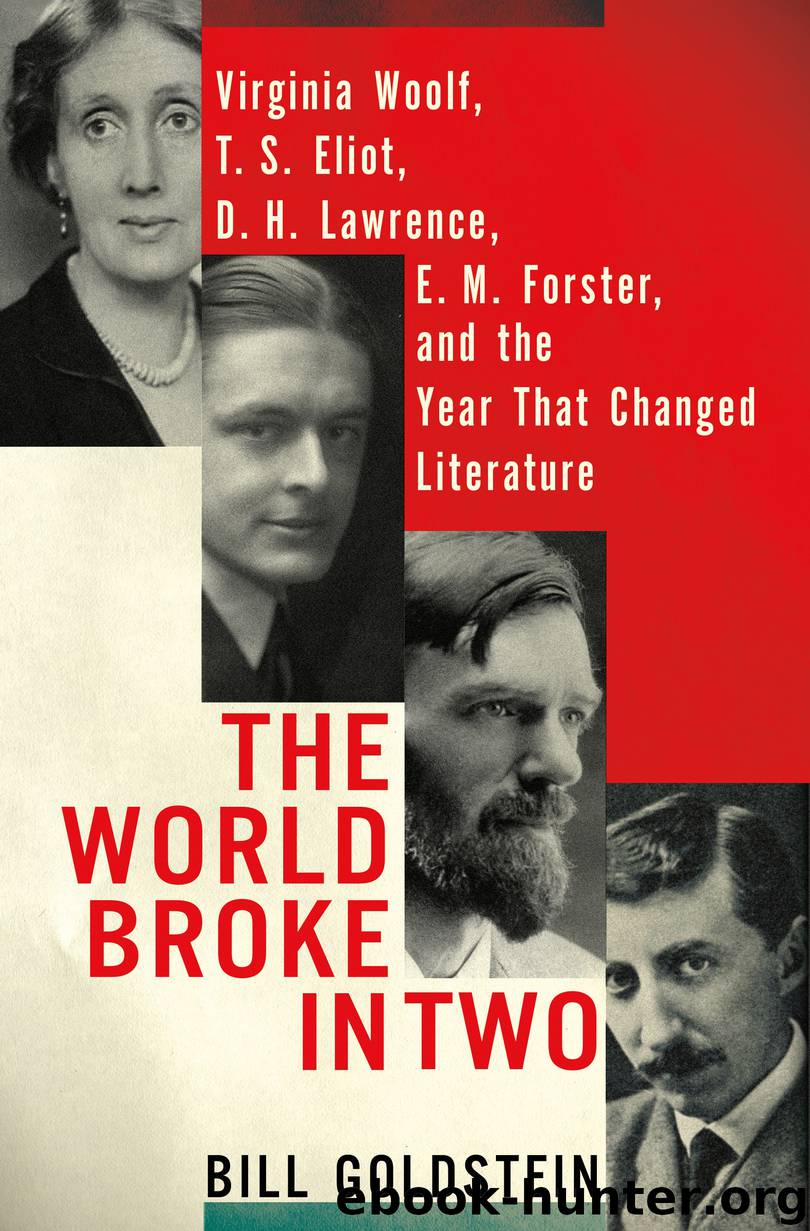
The World Broke in Two by Bill Goldstein
Author:Bill Goldstein
Language: eng
Format: epub
Publisher: Henry Holt and Co.
Chapter 11
WOMEN IN LOVE IN COURT
An attractively printed brochure announced that a 1,250-copy limited edition of D. H. Lawrence’s Women in Love would be published by a new firm, Thomas Seltzer, Inc., in November 1920. The brochure, alluding to the scandal of Lawrence’s The Rainbow and promising the same kind of reading experience with its sequel, did as much as possible to entice readers while doing what it could to avoid provoking the censors.
With Lawrence passion looms large, but great passion is always near to great spirit, and “Women in Love” will eventually baffle the sensation hunters, because Lawrence, although unhesitatingly accepting, even celebrating the flesh, is quick to discover and proclaim the divinest essences.
The title page of the book listed no publisher (“Privately Printed for Subscribers Only”), and the edition sold steadily but modestly over the next eighteen months. Lawrence’s reputation continued to grow, particularly with the successful publication of The Lost Girl in the United States, by Seltzer, and in Britain, but at $15 the subscription edition of Women in Love was an item for rarefied wallets in any case. And when, on a hot Friday afternoon in early July 1922, John Sumner, of the New York Society for the Suppression of Vice, paid an unwelcome call at Seltzer’s offices across the street from St. Patrick’s Cathedral, there were plenty of unsold copies of Lawrence’s novel available to be seized.
Lawrence was in Australia, Eliot in London—but at the beginning of July, New York was the place that mattered most to their futures.
* * *
The New York Society for the Suppression of Vice, founded in 1873, was approaching its fiftieth anniversary. It had been a pioneering organization, the first of its kind in the United States, a private group that, upon its founding, was given law-enforcement responsibilities. Its founder and guiding spirit, Anthony Comstock, had led the organization, funded by the crusading Comstock’s wealthy patrons, for more than four of those decades. When he died, in 1915, he was succeeded by Sumner, a figure who loomed smaller in the public imagination. Comstock’s legend—his belly and whiskers as grandiose as his “lush” prose fulminating against “Base Villains”—proved enduring enough that Margaret Anderson, whose Little Review excerpts of Ulysses were first suppressed in 1917, recalled in her memoirs that the magazine had been “suppressed by Anthony Comstock,” even though he had been dead for two years by then.
The continuing prosecution of the Little Review for its Ulysses excerpts and now of Seltzer for Women in Love was the handiwork of Comstock’s successor, a Long Island stockbroker whose hobbies were golf and driving. Sumner, as nettlesome and indefatigable as Comstock, never escaped his shadow, though he was relentless and successful at policing the “many subdivisions of commercialized vice,” including motion pictures, plays, and photographs and artwork for sale. He was also more inventive than Comstock. Sumner proudly recalled in an unpublished memoir that it had been his own innovation to prosecute a fiction magazine—the Little Review—which was something his predecessor had never thought to do.
Download
This site does not store any files on its server. We only index and link to content provided by other sites. Please contact the content providers to delete copyright contents if any and email us, we'll remove relevant links or contents immediately.
Cecilia; Or, Memoirs of an Heiress — Volume 2 by Fanny Burney(31959)
Cecilia; Or, Memoirs of an Heiress — Volume 3 by Fanny Burney(31945)
Fanny Burney by Claire Harman(26607)
We're Going to Need More Wine by Gabrielle Union(19053)
Plagued by Fire by Paul Hendrickson(17417)
All the Missing Girls by Megan Miranda(16050)
Cat's cradle by Kurt Vonnegut(15365)
For the Love of Europe by Rick Steves(14174)
Bombshells: Glamour Girls of a Lifetime by Sullivan Steve(14081)
Leonardo da Vinci by Walter Isaacson(13341)
4 3 2 1: A Novel by Paul Auster(12403)
The remains of the day by Kazuo Ishiguro(9004)
Adultolescence by Gabbie Hanna(8930)
Note to Self by Connor Franta(7673)
Diary of a Player by Brad Paisley(7587)
Giovanni's Room by James Baldwin(7352)
What Does This Button Do? by Bruce Dickinson(6210)
Ego Is the Enemy by Ryan Holiday(5455)
Born a Crime by Trevor Noah(5385)
